 Indigenous
Overview
Note: This program is a Fleming College program that is being offered at St. Lawrence College. Students will apply and be accepted to Fleming College, and will study at the St. Lawrence Brockville campus.
We provide students with an excellent academic foundation and strong applied skills. Students will develop the knowledge and ability to effectively conduct a client assessment, create ethical treatment plans, deliver safe and effective massage therapy treatments, and evaluate the outcome of treatments. Our professional hydraulic massage therapy tables, large laundry facilities and Clinic Preparation course provides each student with an exceptional practical learning experience.
Our five-consecutive semester program (semester 3 is during summer), is an extremely challenging and rewarding educational experience that provides the pathway to become a Registered Massage Therapist.
Program Details
Program Highlights
Upon successful completion of all courses and clinic experiences within the curriculum, students of the Massage Therapy program will be eligible to graduate and challenge the College of Massage Therapists of Ontario registration examinations. This exam has both a written and practical component and requires a 70% pass rate to become a Registered Massage Therapist in Ontario.
Registered Massage Therapists in Ontario are regulated health professionals whose governing body is the College of Massage Therapists of Ontario. Applicable legislation includes the Regulated Health Professions Act, and the Massage Therapy Act.
Program Outline
2027-2028
This course is designed to provide the student with an understanding of the anatomy and physiology of the human body. It will begin with an introduction to the organization and the cellular/tissue basis of the human body. The systems that will be focused on in this course are: integumentary, skeletal, muscular, nervous and special senses.
Communications 1 for Health Professionals is an introductory course that provides a foundation in college-level communications relevant to professions in health. In this course, students learn to read critically, write appropriately for a variety of audiences, conduct research, cite references, revise for clarity and correctness, and present those results in various formats. In seminars, labs, and modules students will engage in both independent and collaborative activities relevant to health studies, including the development and presentation of a research assignment to help them become more effective communicators in academic and professional environments within in the field of health.
This functional course will provide an overview of the Ontario Healthcare System. Students will examine the interdisciplinary role of healthcare professionals. Based on examination, students will dialogue about current issues and trends that impact the Ontario healthcare system, within the context of sustainability.
This course is designed to introduce the students to the role of the registered massage therapist as a regulated healthcare professional. Content will facilitate student understanding of: the professional role, commitment to practice, ethical concepts (e.g. client-centred care, confidentiality, boundaries), and critical thinking and decision-making.
This introductory, foundational course provides students with the fundamental principles, theory and practice of massage therapy needed to practice as a professional massage therapist. Opportunity is provided to develop beginning skills in the practice of massage in a laboratory setting.
This course introduces students to our on-site massage clinic and the operational aspects of running a clinic. Students will have scheduled hours in the clinic and perform clinic duties as assigned.
This course is designed to provide students with some of the knowledge, skills, and attitudes needed to have successful college and professional careers. It explores the program structure, code of conduct, learning support services, study habits, test taking, presentation skills, time management, and medical terminology.
This course will teach the importance of palpation as both an art and a skill in assessing body tissue. On completion, students will understand the concept of Intelligent Touch and be able to palpate a variety of tissues including skin, fascia, bone, muscle, tendon ligaments, artery, veins, retinaculum & aponeurosis. HTLH 309 prepares students for Palpation 2 HLTH 313.
This course introduces the student to the study of the human body and the terminology used to describe it scientifically. It will examine its regions, positioning, movement patterns, and the basic structures that comprise the musculoskeletal system. This course examines the anatomy of the axial skeleton (head, vertebral column, thorax, abdomen and pelvis). The study of the structures of the musculoskeletal system (bones, ligaments, joints and muscles) and the peripheral nervous system are emphasized. The description of each region is completed with an outline of its vascular supply (arteries and veins) and lymph drainage.
This course is an introduction to the study of Indigenous (First Nations, Metis, and Inuit) peoples in Canada. Students will explore the complex historical and contemporary relationships between Indigenous and non-Indigenous peoples. The course will also guide students to begin to understand the diversity and depth of Indigenous societies, worldviews, and knowledge through a multi-disciplinary lens.
Communications II, building on the foundation of Communications I, is a blended course that teaches students to write and communicate for a variety of professional situations. In seminars, labs and online modules, students will develop a professional portfolio that demonstrates their abilities to meet the challenges of a changing workplace.
This course is designed to provide the student with an understanding of human anatomy and physiology as they pertain to the following systems: Cardiovascular, Lymphatic, Endocrine, Immune, Respiratory, Urinary, Fluids & Electrolytes/Acid-Base and Reproductive.
This Clinical Experience provides the student with a clinical placement to apply the knowledge, skills, and professional attitudes learned in semesters 1 and 2. Students will be guided and evaluated by a clinical instructor.
This course examines the anatomy of the appendicular skeleton (shoulder girdle, upper limb, pelvic girdle, lower limb). The study of the structures of the musculoskeletal system (bones, ligaments, joints and muscles) and the peripheral nervous system are emphasized. The description of each region is completed with an outline of its vascular supply (arteries and veins) and lymph drainage
This course provides an overview of the knowledge, skills, and attitudes needed to evaluate clients in a massage therapy practice, prior to their treatment. On completion students will be able to justify and describe the assessment process and its characteristic sequence and methods. HTLH 312 precedes later courses that focus on how to perform and interpret manual tests in greater detail.
Under the supervision of a technologist, the students will give and receive massage. This course will allow the students to continue to develop the massage therapy techniques they acquired in Introduction to Massage and Ethics.
This course will provide students with the knowledge, skills, and professional attitudes needed to palpate the upper limb, head, neck and face. Superficial and deep structures of the human body palpated include: skin, fascia, bone, muscle, tendons, ligaments and blood vessels.
Standards and Legalities for Massage Therapists is designed to provide the student with the opportunity to understand ethics and law as they currently apply to a Massage Therapy practice in Ontario.
This course builds upon the knowledge of the human body acquired from the first year anatomy and physiology courses. It explores the concept of the homeostatic regulation of the nervous, respiratory, circulatory and muscle systems as well as nutrition. It extents this concept into studying the homeostatic imbalances involved in psychoneuroimmunology, hemostasis, inflammation and pain. The concepts of cellular adaptation, tissue injury and wound healing; neoplasia; and genetic disorders will also be explored.
This Clinical Experience provides the student with a clinical placement to apply the knowledge, skills, and professional attitudes learned in semesters 1 through 3. Students will be guided and evaluated by a clinical instructor.
In this course students will acquire the knowledge, skills, and professional attitudes needed to use joint play as a treatment modality.
This course will provide the massage therapy student with the knowledge, skills, and professional attitude needed to complete a detailed musculoskeletal assessment of a client using gross observation, postural scan, ROM testing, orthopedic tests, muscle strength/length testing, reflexes, dermatomal testing, myotomal testing, joint accessory movement testing, and palpation.
Provides the basis for the massage student to formulate, implement, document and evaluate the effectiveness of a comprehensive plan/program of care (treatment plan); to present appropriate strategies to achieve outcomes related to common impairments (and related functional outcomes) for clients who have a variety of medical histories.
This course provides the basis for the student to create, apply, and evaluate the effectiveness of a plan of care. It examines the clinical decision making process, strategies for treating common impairments, and how to select and achieve goals related to impairments and activities for a variety of clients.
This Clinical Experience provides the student with a clinical placement to apply the knowledge, skills, and professional attitudes learned in semesters 1 through 4. Students will be guided and evaluated by a clinical instructor.
This is a systemic pathology course that examines the major diseases affecting the musculoskeletal, integumentary, cardiovascular, and nervous systems. The etiology, pathogenesis, and clinical features of the various disorders are emphasized, as well as their relevance in massage therapy.
This course provides students with the knowledge, skills, and attitudes needed to interpret results of all assessment tests and methods, identify orthopedic conditions, and form an clinical impression for clients with orthopedic and systemic conditions, prior to the client's treatment.
This course provides students with the knowledge, skills, and professional attitudes needed to find and evaluate research evidence, and to apply it to a clinical practice.
This course will provide students with the knowledge, skills, and professional attitudes needed to palpate the spine, thorax, pelvis and lower limb. Superficial and deep structures of the human body palpated include: skin, fascia, bone, muscle, tendons, ligaments and blood vessels.
This course introduces concepts of psychology that are relevant for the practice of massage therapy, including: muscular, fascial, and autonomic responses to trauma and abuse, altered body image, armouring and body structure, emotional release, psychology of degenerative disease and the dying process, and issues relating to clients with psychopathological conditions, including when to refer.
This course continues the aims of Clinical Treatment I by expanding on the knowledge, skills, and professional attitudes needed to create, apply, and evaluate a plan of care. It describes the clinical thinking process and applies it to clients with orthopaedic and systemic conditions. Conditions and clinical cases will be examined with respect to: signs and symptoms, structures involved, impairments and activity limitations, contraindications and/or precautions, evidence for treatment options, related home-care, progression of treatment, and prognosis.
This course presents a fundamental approach to managing a small firm in the Canadian business environment. It is designed to develop an understanding of planning the start-up of a business, its ongoing management and strategies for growth. Students develop an understanding of the legal forms of business ownership, the importance of financial analysis as a success indicator for the business and appropriate marketing tactics for promoting small business.
This Clinical Experience provides the student with a clinical placement to apply the knowledge, skills, and professional attitudes learned in semesters 1 through 5. Students will be guided and evaluated by a clinical instructor.
This is a systemic pathology course that examines the major diseases affecting respiratory, digestive, urinary, reproductive, and endocrine systems. The etiology, pathogenesis, and clinical features of the various disorders are emphasized, as well as their relevance in massage therapy.
This Law and Ethics Review course is designed to provide the student with the opportunity to review ethics and law as they currently apply to a Massage Therapy practice in Ontario.
This course introduces students to modalities that are commonly studied by RMTs for continuing education credits.
This course prepares students to take the comprehensive Multiple Choice Questionnaire (MCQ) and Objective Structured Clinical Examination (OSCE). Students must pass each in order to graduate from the Massage Therapy Program. These examinations mirror the College of Massage Therapists of Ontario's registration exams. These examinations contain detailed material from all two years of the program.
This course continues the aims of Clinical Treatment 2 by expanding on the knowledge, skills, and professional attitudes needed to create, apply, and evaluate a plan of care. It describes the clinical thinking process and applies it to clients with orthopaedic and systemic conditions. Conditions and clinical cases will be examined with respect to: signs and symptoms, structures involved, impairments and activity limitations, contraindications and/or precautions, evidence for treatment options, related home-care, progression of treatment, and prognosis.
Requirements
Admission Requirements
Ontario Secondary School Diploma (OSSD) or equivalent including the following prerequisites:
- Grade 12 English C level
- Any two Grade 11 or Grade 12 C level sciences
Health Requirements
All immunizations must be completed and reviewed by a health care provider using the Pre-Placement Health Form:
-
Measles, Mumps, Rubella (MMR) - proof of vaccination or immunity.
-
Varicella (Chickenpox) - proof of vaccination or immunity.
-
Tetanus, Diphtheria, Pertussis (Tdap/Td) - current vaccination status, including an adult Tdap booster.
-
Polio - proof of primary immunization series.
-
Hepatitis B - complete vaccination series, often with serology confirming immunity because of potential exposure to blood and body fluids.
-
COVID-19 - dependent on placement site requirements. Some agencies continue to require proof of vaccination.
- Annual Influenza vaccine - often required or strongly recommended by placement partners and health-care facilities
Students must complete all program- and agency-specific requirements.
-
Vulnerable Sector Check (within 6 months)
-
Basic First Aid (valid within 3 years)
-
CPR Level A (valid within 3 years)
Other Requirements
- Independent physical mobility is essential to the Massage Therapy profession.
Fees
2027-2028
Fees are estimates only. Tuition is based on two semesters. Final fees will be posted in Spring 2027 for the 2027-2028 Academic Year.
Fees are estimates only. Tuition is based on two semesters. Ancillary fees will be posted in Spring 2027.
Brockville
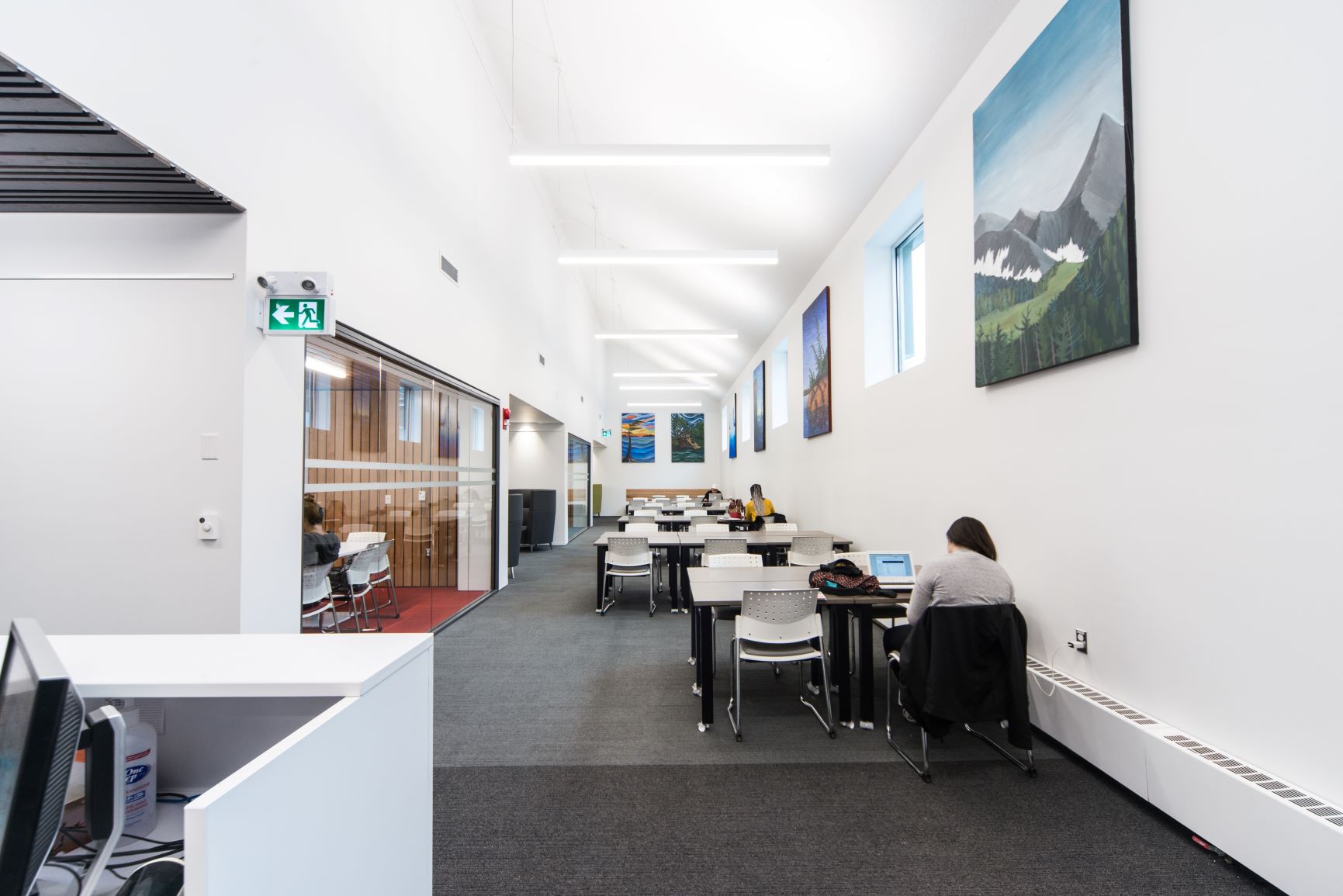
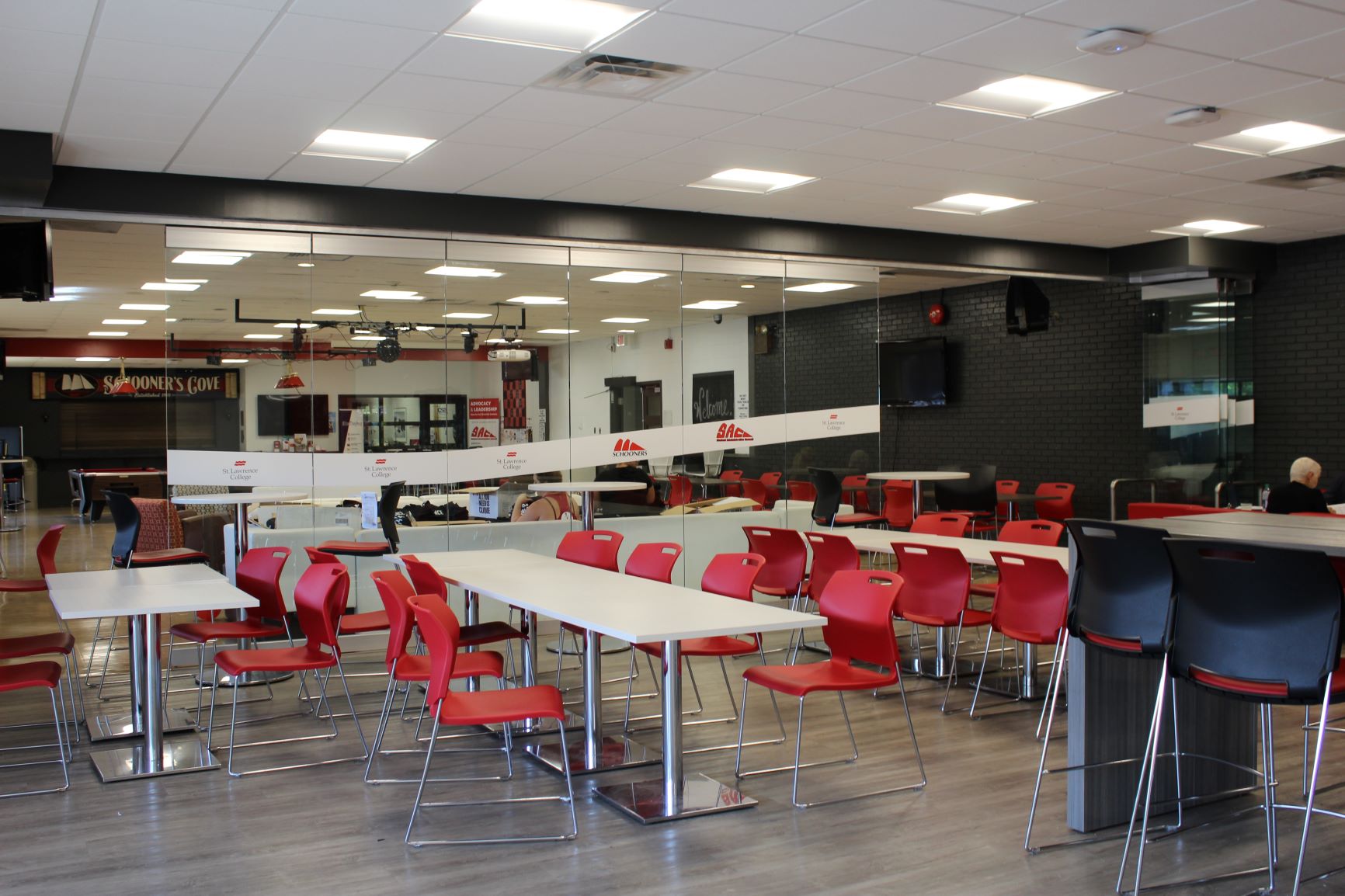
Our Brockville campus has a modernized library, complete with individual and group study space, a newly renovated cafeteria, student common lounges, and more.
Career Opportunities
With a Massage Therapy Advanced Diploma you have the opportunity to choose to work independently, setting your own hours, or as part of a team. As a Registered Health Professional (RHPA Act), Registered Massage Therapists work in Chiropractic and Physiotherapy clinics, Athletic and Sport facilities, Spa's, Cruise Ships, Hotels, Corporate Offices, private practice (either in home office or with other RMTs), and Hospice and Palliative Care centres.
Other Information
The St. Lawrence College of Applied Arts and Technology (“St. Lawrence College”) is currently pursuing an amalgamation with The Sir Sandford Fleming College of Applied Arts and Technology (“Fleming College”), with a proposed effective date of April 1, 2027, subject to approval by the Ministry of Colleges, Universities, Research Excellence and Security. If the proposed amalgamation proceeds, students admitted to St. Lawrence College or Fleming College may ultimately study at, and receive their credential from, the amalgamated institution, which may have a different name than the institution to which they originally applied.
Program Contacts
For questions about this program, please contact askus@flemingcollege.ca